
Graffiti isn’t just an eyesore—it’s an invoice. In Oakland, property owners who don’t erase a fresh tag within ten days face penalties of up to US $6,200 per incident—more than many small businesses spend on maintenance in a whole quarter. Multiply that by a few repeat hits and the sticker shock rivals a capital‑improvement project you never budgeted for.
Yet the real damage goes deeper. Spray‑painted walls erode tenant confidence, invite copy‑cat vandals and broadcast to prospects that “no one’s watching.” Add accelerated façade repairs, rising insurance premiums and the soft cost of management headaches, and graffiti becomes a silent profit‑killer for portfolios of every size.
Most owners respond with the same two steps: buy more paint and call the night guard. It rarely works. Tags re‑appear faster than you can order rollers, lighting upgrades are piecemeal and anti‑graffiti coatings alone can’t protect windows, doors or blind corners. The cycle repeats, curb appeal slides and the expense ledger keeps swelling.
There’s a Better Way
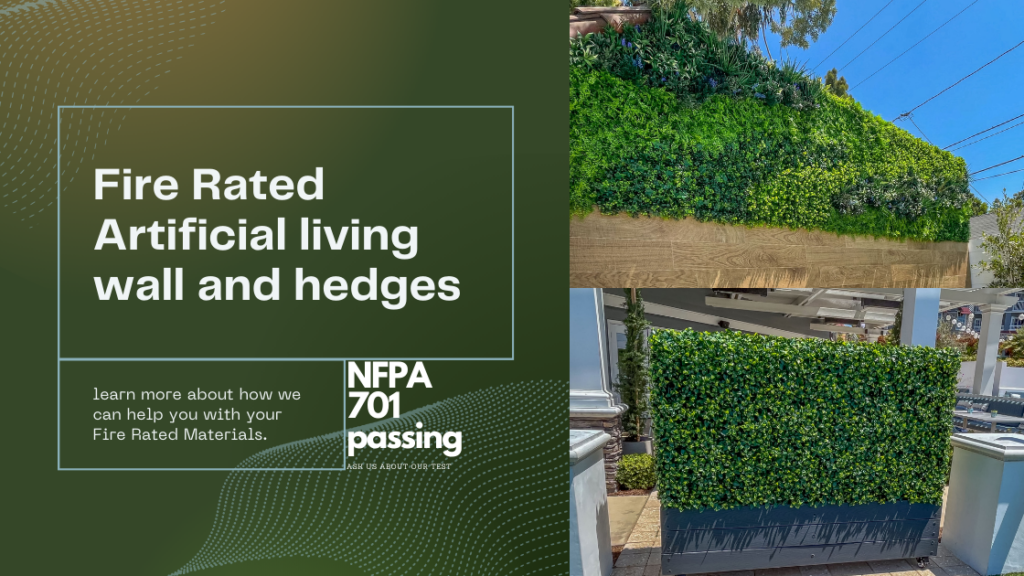
This guide delivers a seven‑step, evidence‑backed playbook that merges proven Crime‑Prevention‑Through‑Environmental‑Design (CPTED) tactics with a breakthrough physical deterrent: NFPA 701‑rated artificial living walls from Geranium Street USA. Unlike bare concrete or painted stucco, which provide the perfectly flat “canvas” vandals crave, our dense boxwood and ficus foliage create a textured, irregular surface that’s virtually impossible to tag. And because every panel passes the NFPA 701 textile & film flame‑propagation test, they meet California fire codes while delivering year‑round greenery without irrigation, fertilizers or pest control.
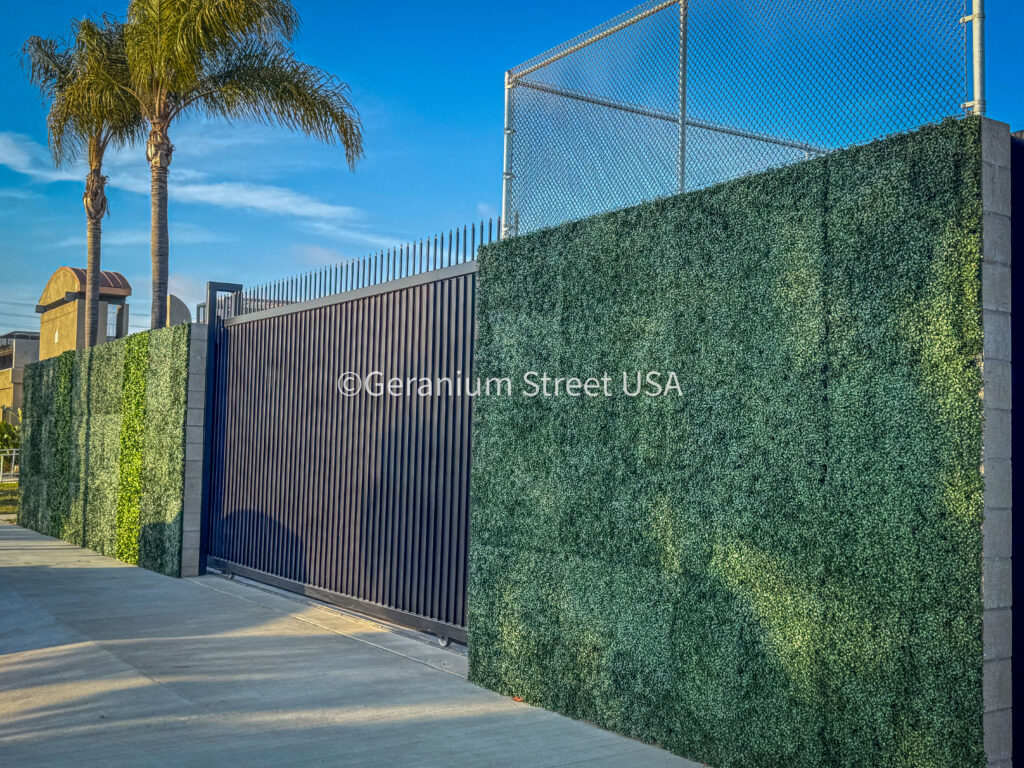
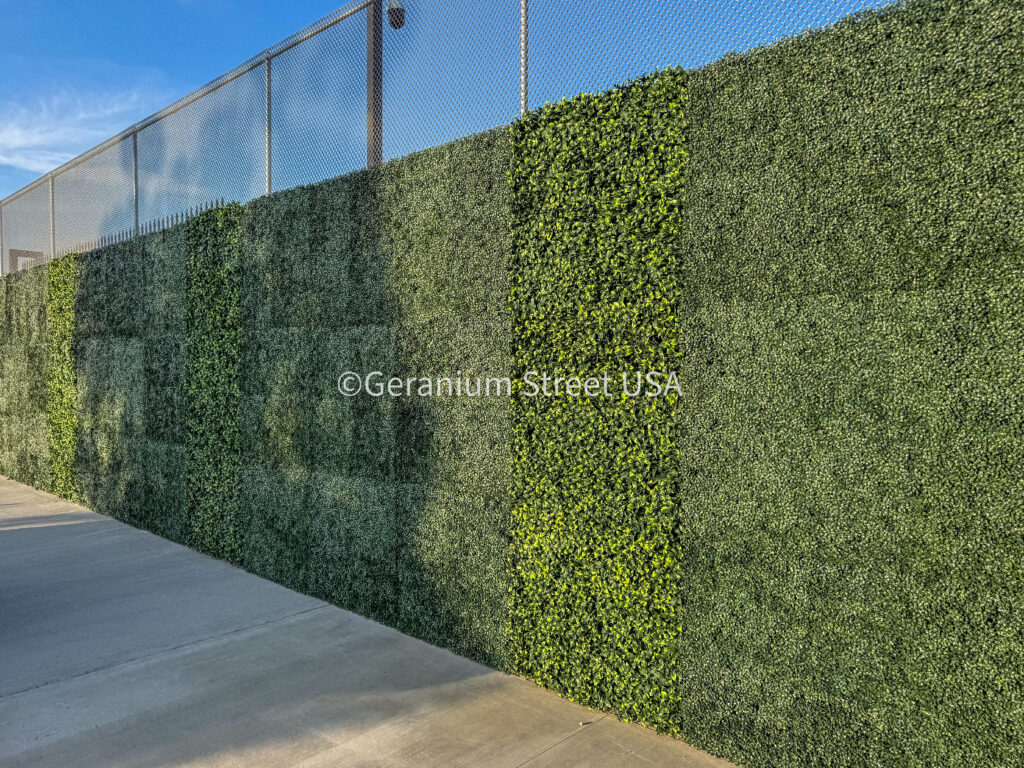
We’ve already proven the concept at scale. On a high‑traffic block in Compton, CA, we wrapped an 80‑foot wall in an alternating pattern of NFPA 701‑certified boxwood and ficus panels. Six months later the surface is 100 % graffiti‑free—a first for that corridor—and the maintenance crew hasn’t spent a single minute repainting. (You’ll see the photo and ROI numbers in Section 5.) Total installed cost? Less than a single year of repetitive paint‑overs.
What You’ll Gain From This Playbook
- Calculate your true cost of graffiti—fines, labor, reputation and insurance.
- Rank the seven prevention tactics by ROI and implementation speed.
- See why a living‑wall + coating hybrid often delivers the lowest five‑year cost of ownership.
- Walk away with an implementation roadmap you can hand to your facility team—or outsource to us.
If you’d rather shortcut the process, click any “Book a Design Consult” button and our engineers will send you a no‑obligation site mock‑up complete with material specs, cost estimate and compliance documentation.
Need a deeper dive into fire safety? Check out this explainer on NFPA 701‑certified foliage to understand why compliance matters for every retrofit project.
1. The Real Cost of Graffiti on Commercial Sites
Graffiti may start with a single spray‑can, but it ends with a line‑item avalanche that punches holes in your operating budget. Below is what most property teams overlook when they price “a quick paint‑over.”
| Cost Category | Typical Range (USD) | Why It Adds Up |
|---|---|---|
| Removal Labor & Materials | $3.50–$7.00 per sq ft | Includes specialty chemicals, pressure‑washing or repainting—often repeated 3‑4 times per year on high‑risk walls. |
| Municipal Fines & Admin Fees | Up to $6,200 per incident | Cities like Oakland start the clock at 10 days; repeat violations escalate quickly. |
| Insurance Premium Hike | 3 – 5 % annually | Carriers view persistent vandalism as evidence of inadequate risk controls. |
| Tenant Turnover / Rent Concessions | 1–2 months’ rent per suite | Graffiti‑blighted entrances reduce perceived safety, forcing landlords to offer discounts or face vacancies. |
| Reputation & Foot‑Traffic Loss | Hard to quantify—often 5–15 % revenue dip | A Federal Reserve study links visible blight to measurable declines in local commerce. |
Exact fine varies by jurisdiction; always confirm your local ordinance.
The Snowball Effect: Why “One Tag” Rarely Stays One
Graffiti is a social signal. Leave a fresh tag unchecked and you invite more in its wake, a phenomenon criminologists call the “broken‑windows theory.” The National Institute of Justice notes that visible vandalism can increase total property crime by up to 11 % within a year. Translation: each delay in removal expands the target and the budget you’ll need to reclaim it.
How Quickly Costs Spike — A Real‑World Scenario
Consider a 120‑linear‑foot rear wall on a retail plaza:
- Tag appears Monday night—approx. 480 sq ft surface area.
- Contractor quotes $2,400 for chemical removal (at $5/sq ft) plus $350 in traffic‑control fees.
- The spraying crew can’t mobilize until the following Monday. City inspector photographs the tag on Thursday and issues a $850 citation.
- Total Week 1 cost = $3,600. Repeat three more times this year and you’ve burned through $14,000+—not counting higher insurance premiums next renewal.
Intangible—but Very Real—Brand Damage
Survey research by the KPMG Consumer Barometer shows 65 % of shoppers are less likely to enter a store fronted by graffiti. For corporate campuses and tech parks, that perception extends to talent acquisition, nobody wants their new hire’s first impression to be a tagged reception wall.
Fast‑Track Solution: Skip the paint‑over loop. Explore a NFPA 701‑rated artificial living wall that removes the “canvas” altogether and pays for itself in as little as 18 months.
Bottom Line
When you add up labor, fines, premium hikes and opportunity costs, each 100 sq ft of untreated graffiti can exceed $10,000 in direct and indirect losses over a five‑year span. Traditional paint‑over cycles may feel cheap in the moment, but they solve nothing long‑term.
In the next section, we’ll expose why the most common “solutions” fail within 30 days and set the stage for a prevention plan that actually sticks.
2. Why Most “Graffiti Solutions” Fail After 30 Days
Every city maintenance yard has the same graveyard of half‑effective fixes, buckets of mismatched paint, cans of chemical stripper, and a few rolls of anti‑tag film that never made it past the loading dock. The reason is simple: single‑point solutions treat symptoms, not root causes. Below are the six most common pitfalls that sabotage well‑intentioned prevention plans within the first month.
-
Delayed Removal Breeds Copy‑Cats
Graffiti is a social currency: the longer a tag stays visible, the higher its “status” in vandal circles. Leave it up for more than 48 hours and you telegraph that your building is an easy mark. U.S. Department of Justice guidelines note that immediate removal can cut repeat incidents by up to 80 % in the first year.
-
Paint‑Overs Create a Patchwork Canvas
Quick roll‑outs rarely match the original wall color, producing a “quilt effect” that invites more tagging (new surface, same notoriety). Over time you end up with more layers of paint than drywall and still no deterrent.
-
One‑Size‑Fits‑All Coatings Don’t Fit Every Substrate
Siloxane sealers excel on unpainted masonry but fail on metal doors; polyurethane top‑coats yellow in UV‑heavy climates. Choosing the wrong chemistry guarantees ghost shadows that require re‑grinding, an expensive second job. (Spoiler: our living‑wall cladding eliminates the substrate‑compatibility issue altogether.)
-
“Set‑It‑and‑Forget‑It” Lighting Upgrades Fall Dark
Facility teams often install bright fixtures but forget lumen‑maintenance schedules. LEDs dim over time; a 10 % drop in brightness can reduce surveillance‑camera clarity enough that vandals regain confidence.
-
CPTED Blind Spots—Literally
Crime‑Prevention‑Through‑Environmental‑Design principles stress clear sightlines, yet many retrofits leave dumpsters, alcoves and stairwells untouched. These “shadow zones” become entry points for taggers, nullifying your investment everywhere else.
-
No Written Maintenance SLA
Even the best coating or camera system fails without a response timetable. Municipal studies show graffiti removal programs with a published 24–48‑hour SLA experience 52 % fewer incidents after six months (City of Seattle audit).
Compton Wall Snapshot: Proving the Multi‑Layer Approach
Our 80‑ft Compton installation broke the cycle by combining three tactics at once rapid removal of legacy tags, a sacrificial nano‑coating on exposed steel doors, and a NFPA 701‑rated artificial living wall over the primary façade. Six months in, no re‑tags, no coating failures, no mismatched paint.
Did You Know? The average tagger spends just 60–90 seconds on a hit. Textured foliage panels force them to slow down—or walk away entirely, dramatically raising the chance of detection.
For a deep dive on pairing coatings with artificial greenery, read our guide to hybrid graffiti‑deterrent walls.
Ready to ditch one‑off fixes? Request a free site assessment and receive a customized prevention matrix within two business days.
3. The 7‑Step Graffiti‑Prevention Playbook
Below is the integrated framework our facility clients use to cut graffiti incidents by 65 % or more in the first year. Follow the steps in order—each layer multiplies the effectiveness of the next.
Step 1 – Establish a 24‑Hour Reporting Protocol
Create a dedicated email or SMS line for tenants, staff and security to report tags the moment they appear. Assign a single manager to triage images, log square footage and dispatch the removal crew.
- Tool tip ⇢ Use a free photo‑timestamp app so every report includes date, time and location metadata.
- Response goal ⇢ Plan for initial removal within 24–48 hours; anything slower signals vulnerability.
Resource: U.S. DOJ Graffiti Removal Action Guide
Step 2 – Upgrade Lighting & CCTV Sight Lines
Pair broad‑spectrum LED fixtures (4,000–5,000 K) with motion‑activated cameras that cover every 8 ft of wall length. According to the National Institute of Justice, well‑lit areas with visible cameras experience a 23 % reduction in property crime.
- Position luminaires above potential tag zones to avoid upward shadowing.
- Include quarterly lumen‑output checks in your maintenance SLA.
Step 3 – Apply Substrate‑Specific Anti‑Graffiti Coatings
Select chemistry based on surface:
| Surface | Best Coating Type | Re‑application Cycle |
|---|---|---|
| Unpainted Masonry | Breathable Siloxane | 5 yrs |
| Metal Roll‑Up Doors | Two‑Part Polyurethane | 3 yrs |
| Glass & Plex | Sacrificial Nano‑Film | Replace as needed |
Always test in an inconspicuous spot first—the wrong product can trap moisture and cause spalling.
Step 4 – Eliminate the “Canvas” with NFPA 701‑Rated Artificial Living Walls
Flat, uniform walls invite tags. Our NFPA 701‑certified boxwood and ficus panels introduce dense texture that spray paint won’t adhere to evenly. They install over concrete, CMU, metal, or wood with a galvanized wire‑mesh backing, no irrigation, no soil and zero risk of root intrusion.
- Fire code compliance ⇢ Each panel carries a passing NFPA 701 Method 2 report and is California Fire Marshal–approved.
- Service life ⇢ UV‑stable foliage rated for 5‑7 years before color touch‑up.
- Maintenance ⇢ Quarterly hose‑down; no trimming or fertilizers.
See it in action → Download the one‑page NFPA 701 Living‑Wall Spec Sheet or book a design consult for your property.
Step 5 – Trim Landscaping for Clear Sightlines
Keep shrubs below three feet and tree canopies above eight feet to maintain unobstructed views, core CPTED principles. Well‑trimmed perimeters amplify the deterrent effect of both cameras and lighting while showcasing your new living wall.
Step 6 – Engage the Community with Approved Art Programs
Mural partnerships can humanize blank walls outside high‑profile façades while channeling local artistry into sanctioned spaces. Studies from the Brooklyn Museum show neighborhoods with approved art zones see 50 % fewer illegal tags.
Step 7 – Lock in an Ongoing Inspection & Maintenance Schedule
Finally, codify the first six steps into a service‑level agreement:
- Daily – Security walk‑through & photo log
- Weekly – Lighting and camera status check
- Quarterly – Living‑wall rinse and hardware tighten‑up
- Annual – Coating spot tests & landscape pruning audit
Assign budget lines to each task so funding renews automatically,no scrambling for purchase orders after the next tag hits.
Need a turnkey roadmap? Our team can implement all seven steps under one contract. Request a bundled quote and get projected payback in less than 48 hours.
4. Spotlight | NFPA 701‑Certified Artificial Living Walls
Conventional wisdom says you can’t beat graffiti: tags will always reappear. Our experience says otherwise—if the wall itself ceases to be a usable “canvas.” Dense, fire‑safe foliage does exactly that.
Why Texture Beats Paint
- Disrupts Spray Patterns ⇢ Spray tips atomize paint for smooth coverage; uneven boxwood leaves scatter droplets and create blotches vandals hate seeing in their feeds.
- Zero Dry Time ⇢ Unlike wet paint or coatings, foliage offers no curing window for taggers to exploit.
- Instant Visual Appeal ⇢ Greenery elevates curb appeal, turning a liability wall into a biophilic statement piece.
NFPA 701 Compliance = Peace of Mind
Every Geranium Street panel carries a current NFPA 701 Method 2 test report. That means:
- Meets California Fire Code & (most) municipal requirements for non‑structural decorative materials.
- Accepted by insurers for fire‑resistance credits.
- Qualifies for many LEED and WELL biophilic‑design points.
Installation Snapshot
- Galvanized 4 × 4 in. wire mesh anchored to substrate.
- Boxwood & ficus mats clipped with UV‑stable fasteners (no adhesives).
- Perimeter trim finished with powder‑coated aluminum for a clean, tamper‑resistant edge.
Total install time for a 100‑linear‑foot wall: ≈ 1 day with a 3‑person crew.
Curious how it would look on your façade? Upload a photo and get a free Photoshop mock‑up within 48 hours.
5. Design Inspiration | Compton, CA Case Study

| Metric (First 6 Months) | Result |
|---|---|
| Graffiti Incidents | 0 (previous yearly average: 12) |
| Maintenance Hours | 1 hr (hose‑down rinse) |
| Estimated Cost Avoided | ≈ US $8,400 |
Design Note: The checkerboard pattern disrupts long sightlines, making it even harder for vandals to visualize a tag. Clients often replicate this layout for retail alleys and loading docks.
Download the full spec package → PDF (1.2 MB)
6. Cost‑Benefit Analysis | Coating‑Only vs. Hybrid Living Wall
| 5‑Year Scenario | Coatings Only (120 lf × 10 ft) |
Hybrid Living Wall (NFPA 701 Foliage) |
|---|---|---|
| Up‑Front Materials | $12,200 | $28,000 |
| Installation Labor | $4,800 | $6,300 |
| Graffiti Removal (3×/yr) | $18,000 | $0 |
| Municipal Fines Avoided | — | $6,200+ |
| 5‑Year Total Cost | $35,000+ | $27,300 |
Even with a higher day‑one price, the hybrid solution pays for itself in ≈ 18 months thanks to zero removal events and avoided fines.
Bottom line: Expect a net savings of $2,700–$5,000 over five years for every 100 linear feet retrofitted with living wall panels.
7. Implementation Roadmap | From Site Audit to Zero Tags
- Virtual Walk‑Through (24 hrs)
Submit photos or host a live video call; we flag high‑risk zones and measure lineal footage. - Concept Mock‑Up & Budget (48 hrs)
Receive a Photoshop overlay, materials list and fixed bid including coatings, foliage and hardware. - Permitting & Fire Code Check (1–2 wks)
We supply NFPA 701 certificates for AHJ review; most projects qualify as minor exterior alteration with same‑day over‑the‑counter permits. - Installation (1–3 days)
Our crew pre‑assembles panels off‑site to minimize disruption; typical productivity is 400 sq ft per day. - Maintenance Handoff (Day 1 Post‑Install)
Your team gets a one‑page care guide—quarterly hose‑down, annual hardware check. - Year‑1 Review (12 mos)
We revisit, document ROI, and plan expansions if desired.
Ready to start? Click Book My Design Consult and lock in your project timeline today.
8. Frequently Asked Questions | Graffiti Prevention & NFPA 701 Living Walls
Q1. How do artificial living walls actually prevent graffiti?
Q2. Are NFPA 701‑rated foliage products compliant with California fire codes?
Q3. What is the best anti‑graffiti coating to pair with a living wall?
Q4. Does a living wall attract pests or need irrigation?
Q5. How quickly must graffiti be removed to avoid city fines?
Q6. What does a turnkey installation cost per square foot?
Q7. Can I install artificial foliage on curved or uneven walls?
Still have questions? Send us a message and our engineers will respond within one business day.
9. Conclusion & Next Steps
Graffiti doesn’t have to be an endless repaint cycle. By layering fast removal, the right coatings, upgraded lighting and—most critically—NFPA 701‑certified artificial living walls, you transform a liability façade into a zero‑maintenance asset that pays for itself in under two years.
If you’re ready to reclaim your walls and your budget:
- Book your free design consult → Contact Geranium Street USA
- See the specs → Download NFPA 701 certificate & product sheet
- Share with your GC → Compton case‑study PDF
Take action now and your next quarterly report could read “Graffiti