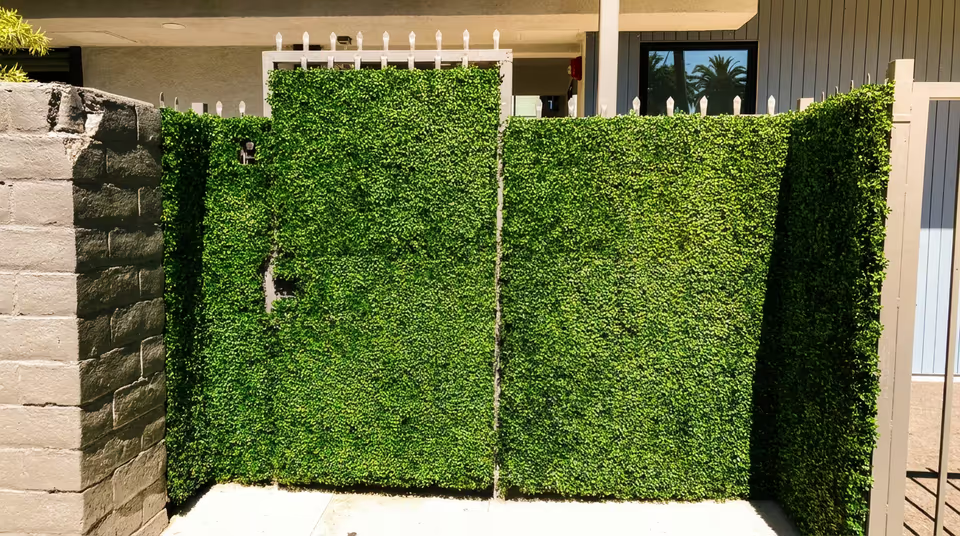
Artificial Boxwood Fence Cover for Existing Fences
Artificial boxwood fence cover is cladding: boxwood mats or hedge panels attached over an existing chain-link, wood, metal, or masonry fence, barrier, or gate to change its visible face, without repairing the structure beneath it.
From $6/sq ftUV boxwood mats
Material only, before delivery and installation; quoted per project.
Covering an existing structure.
Everything here is about covering an existing fence, wall, barrier, or gate with artificial greenery. Covering is possible when the fence is sound and the attachment is confirmed for that fence type. For flexible-mat case planning, see boxwood hedge mats; for freestanding privacy hedges, see boxwood hedge systems.
- Cladding, not repair
- The existing fence, wall, posts, anchors, and gate hardware remain separate structural responsibilities.
- Substrate-specific
- Chain-link, wood, metal, masonry, barriers, and gates require different attachment planning.
- Product-specific
- Review exposure and request fire documentation for the exact selected product.
- Starting rate
- UV boxwood mats from $6/sq ft, before delivery and installation; quoted per project
- Two fulfillment paths
- Nationwide product support; California installation through Califauxscapes.
- Start with
- Photos, dimensions, substrate, exposure, and gate details. The planner below organizes those inputs before you inquire.
The attachment path changes with the surface
The descriptions below are planning categories, not universal installation instructions.
Pick the surface you have
Chain-link or open mesh
- Common planning path
- Ties, clips, edge restraint, or a secondary support layer
- Questions to resolve
- Mesh condition, tie material, spacing, edges, wind, access, gate movement
- Do not assume
- That every mesh gauge or post system can accept the same load
Hardware, spacing, anchors, backing, and installer responsibility are selected for the actual project. Fence-by-fence notes are in the fence types guide.
All five surfaces, side by side
| Existing condition | Common planning path | Questions to resolve | Do not assume |
|---|---|---|---|
| Chain-link or open mesh | Ties, clips, edge restraint, or a secondary support layer | Mesh condition, tie material, spacing, edges, wind, access, gate movement | That every mesh gauge or post system can accept the same load |
| Wood fence | Attachment into suitable rails or a secondary backing system | Rot, rail location, fastener path, moisture, finish, service access | That boards alone are the correct structural attachment point |
| Metal or ornamental fence | Ties, clamps, or a secondary frame that respects the finish | Bar spacing, coating, corrosion, edges, gates, drainage, hardware clearance | That drilling or welding is acceptable to the owner or manufacturer |
| Concrete, masonry, or barrier | Furring, support grid, plates, or anchors selected for the substrate | Substrate type, anchor zone, waterproofing, cracks, edge distance, installer scope | That adhesive alone or one anchor type works everywhere |
| Sliding, swinging, or rolling gate | Lightweight product and attachment that preserves operation and access | Hinges, track, rollers, latch, controls, egress, clearances, added wind area | That a static-fence detail can be copied onto a moving gate |
First-party proof across five substrates
These examples show why the support and attachment condition must be understood before the visible hedge product is specified.
- Access-control gate
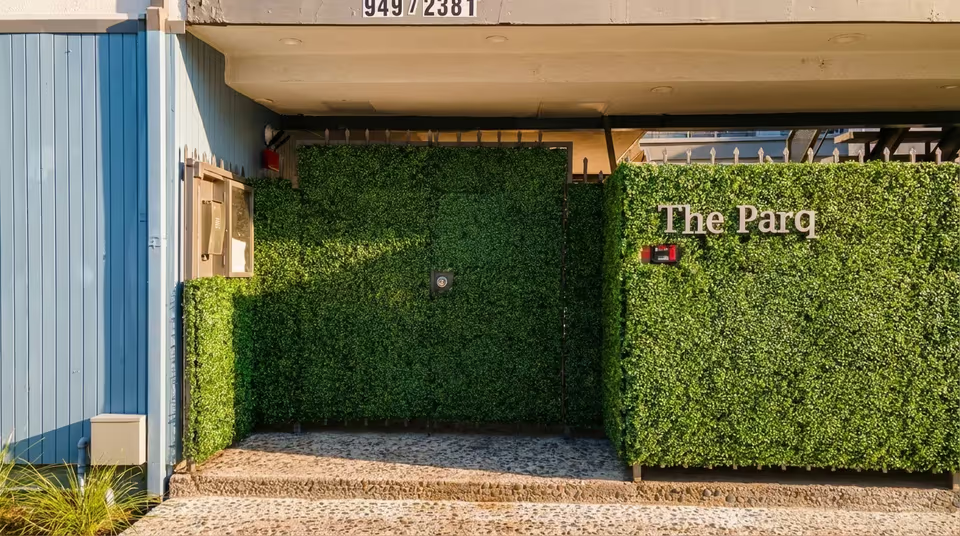
LA apartment security gate
A 360-square-foot artificial boxwood installation on an access-control security gate.
View project - Concrete barrier
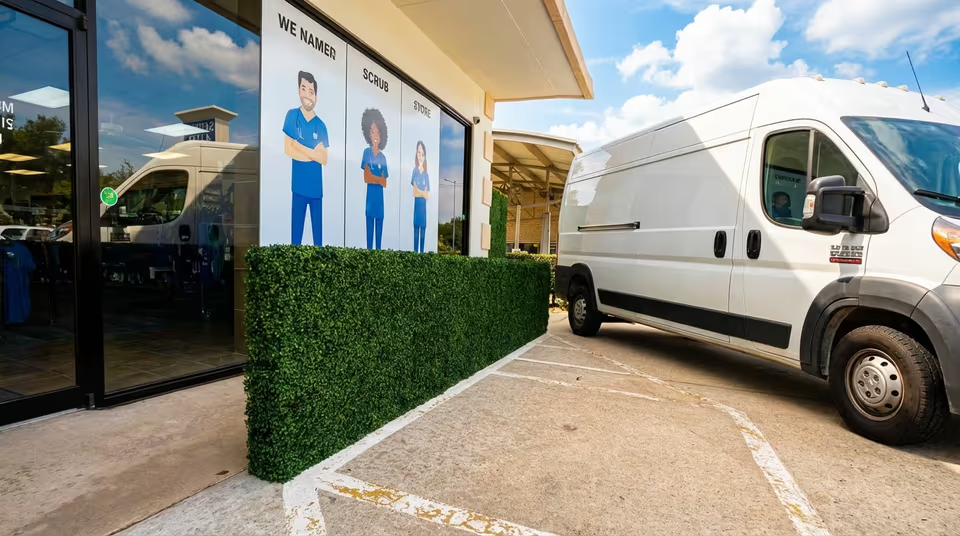
Houston storefront
Custom plates created attachment points while the required concrete barriers stayed in place.
View project - Existing wall
Pool-wall screening
An existing residential wall received a finished greenery face rather than being removed and rebuilt.
View project - Block wall, metal railing
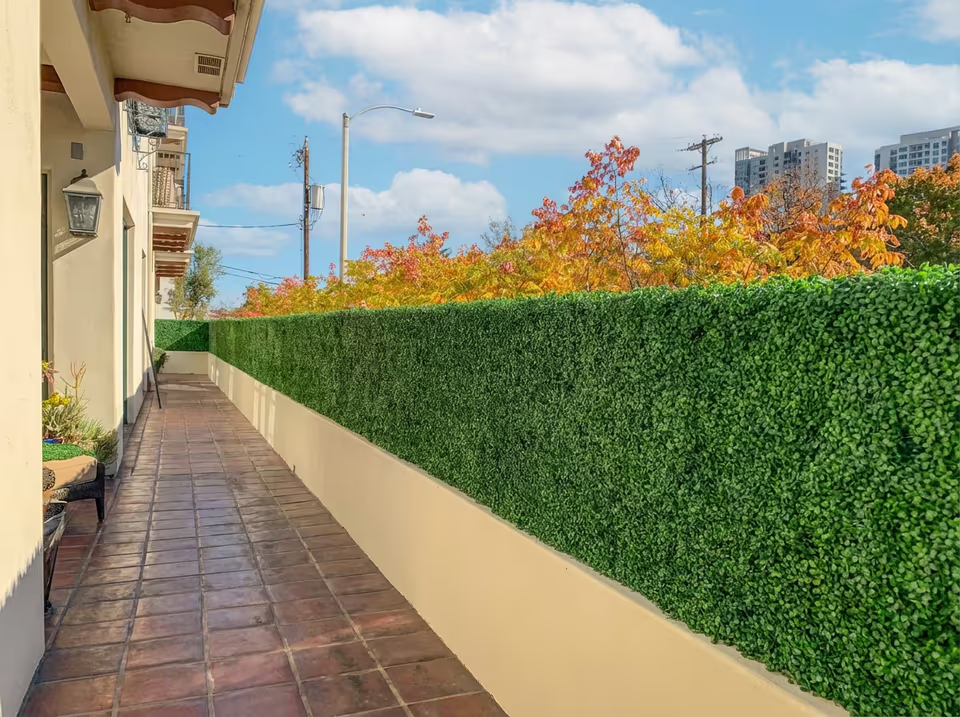
Downtown LA street-side privacy
Thin-profile panels sit atop an existing block wall, using its metal railing as the mounting point.
View project - Open-mesh kennels
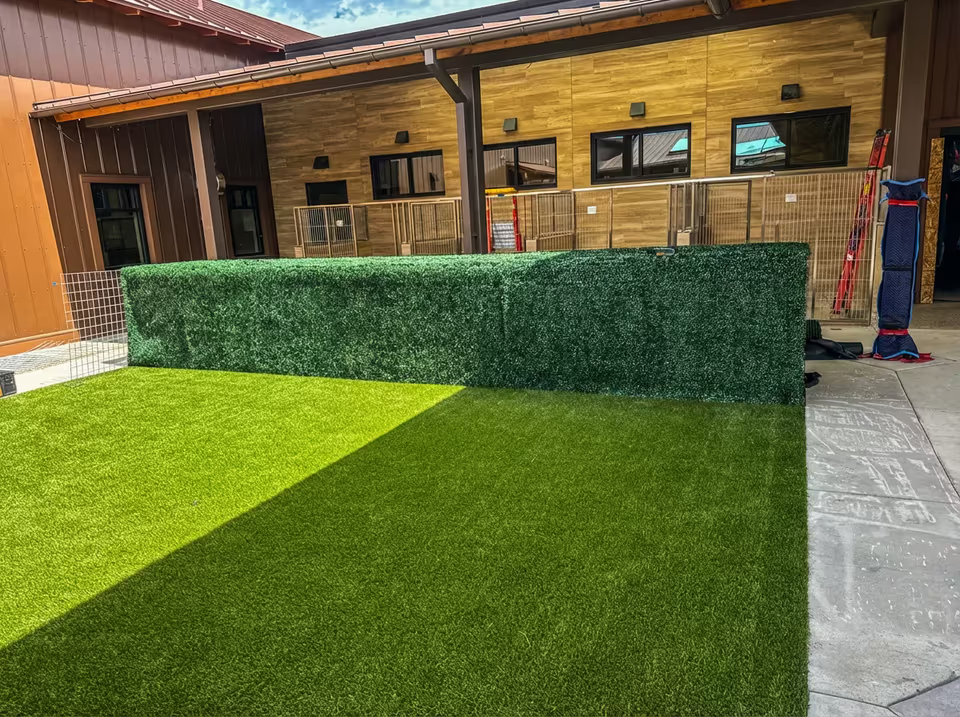
Reno dog park
400 linear feet of custom hedge panels for kennel privacy screening.
View project
Cover the surface after understanding the structure
A fence-covering project adds product, attachment hardware, and wind area to an existing condition. The visible greenery and the supporting structure should not be treated as one interchangeable specification.
What hedge covering can do.
Change the visible finish, add visual screening, unify mismatched surfaces, support a branded or hospitality look, and reduce reliance on live planting maintenance.
What hedge covering does not do.
Repair weak posts, correct damaged rails, certify anchors, increase gate capacity, hide the yard from every viewing angle, establish structural adequacy, or create automatic code approval.
Do not attach product to a damaged or uncertain structure without assessment.
A freestanding screen may be the better path when the existing fence or wall should not carry added attachment or wind loads. Compare freestanding boxwood hedge systems.
Price the run.
Run length times height, at the starting rate for UV boxwood mats.
sq ft of face
- UV boxwood mats
- from
Starting material estimate at $6/sq ft, before delivery and installation; quoted per project. The rate covers UV boxwood mats only; a framed or custom system is quoted on its own. A person is drawn for scale.
One fence may need a mat, panel, frame, or independent screen
The correct product route depends on the surface and the finished condition—not the fence length alone.

Boxwood mats
Flexible surface product. For case-based coverage, trimming, curves, columns, cutouts, and surfaces where a smaller interlocking format is appropriate.
Use the mat calculator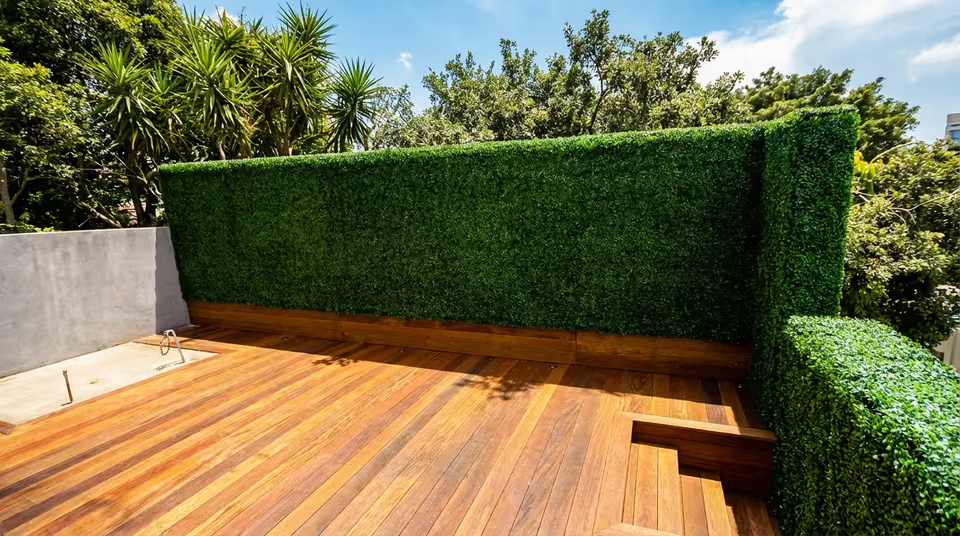
Custom hedge panels
Framed system. For larger fixed, framed, mobile, or freestanding systems when the existing fence should not be the sole support.
Compare boxwood hedge systemsQuantity planning: use the dedicated boxwood-mat calculator when the exact mat format is the selected product. Do not transfer that case calculation to a framed or custom system.
Build the right project brief before selecting a panel
The planner creates a routing recommendation and a concise brief. It does not select anchors, certify the structure, or replace field review.
Build a substrate-specific attachment plan
Photographs and dimensions are needed before selecting the product format or attachment path.
Request a Product Quote Review fire-document requirements →Send enough information to separate product from installation
A complete brief lets Geranium Street identify the likely product, questions for the installer, and whether Califauxscapes should handle the California field scope.
Photographs, dimensions, and movement
Document the existing condition.
- Overall length, height, returns, corners, openings, and grade changes.
- Close photographs of posts, rails, mesh, boards, bars, masonry, anchors, and damage.
- Gate type, swing or slide direction, track, hinges, rollers, latch, and access controls.
- Interior or exterior exposure, known wind, drainage, nearby heat, and service access.
Privacy, edges, documents, and fulfillment
Define the desired finish.
- Visual softening, full screening goal, branded finish, or hospitality application.
- Preferred foliage appearance, visible edges, top finish, and treatment around openings.
- Any venue, property manager, architect, fire marshal, or AHJ documentation request.
- Project location, target date, product shipment without installation, local contractor, or California installation.
Artificial boxwood fence-covering questions
The exact substrate and selected product remain authoritative over broad installation language.
Can artificial boxwood panels cover an existing chain-link fence?
They can be considered for chain-link and other open-mesh fences when the existing structure is suitable. Tie or clip material, spacing, edge restraint, wind exposure, gate movement, and product format must be reviewed for the project.
Can artificial hedge panels be attached to wood, metal, or masonry?
Possible attachment paths differ by substrate. Wood may use rails or a secondary backing; metal may use ties, clamps, or a frame; masonry commonly needs furring, a support grid, or anchors selected for the actual substrate by the installer.
Does a boxwood fence cover repair a weak or damaged fence?
No. Artificial greenery is cladding, not structural repair. Posts, rails, mesh, fasteners, anchors, gates, and adjacent construction should be assessed before adding product, attachment hardware, or wind area.
How do I estimate boxwood-mat quantity for a fence?
Use the dedicated boxwood-mat calculator with the fence width and height, then add an allowance for cuts, openings, edges, overlaps, and field conditions. The final order should be checked against the exact product and layout.
Who installs artificial fence covering?
Geranium Street provides product selection, specifications, quotes, and nationwide shipping support. California installation is handled by Califauxscapes. Outside California, local installation scope and responsibility are confirmed for the project.
Are fire-documented fence-covering products available?
Applicable products may have product-specific fire documentation. The exact material must match the documentation submitted, and the venue or authority having jurisdiction decides whether it is acceptable for the project.
Photograph the structure before choosing the greenery
Send the full fence or wall, close views of the support and damage, dimensions, gates, exposure, location, desired finish, and any reviewer requirement. Current product, price, freight, availability, and installation path are confirmed from the project.